12. Scheduling Algorithms
Real Time Operating Systems (RTOS) •
Dispatching Algorithms
Determines task execution order and efficiency
First Come First Served (FCFS)
- Essentially FIFO
- Processes chose from the front of the ready queue in order of arrival
- Pros:
- Better for long processes
- Cons:
- May lead to poor turnaround due to convoy effect
- Not ideal for short processes, as it can cause delays in execution
Shortest Process Next (SPN)
- Also known as Shortest Job First (SJF)
- Selects shortest job in the ready queue for execution
- Pros:
- Optimal average Turnaround Time (TAT) if all jobs arrive together…
- Cons:
- …but risk of starvation for long processes
- Assumes knowledge of job lengths
Shortest Remaining Time (SRT)
- Pre-emptive version of SPN
- Prioritises process with shortest remaining process time
- Pros:
- Good turnaround time
- Avoids bias to longer processes
- Low overhead
- Cons:
- Need estimate of required processing time
Round Robin
- Also known as time slicing
- FCFS, but with clock based pre-emption
- Each process gets a time slice (quantum) to execute
- Smaller quantum reduces response time
- Too small can increase overhead
- Favours processor-bound processes
Virtual Round Robin
- Involves multiple process queues
- I/O queues feed into auxiliary queue
- Auxiliary queue is prioritised over ready queue for process execution
- i.e., Helps manage process priorities efficiently in a multi-process environment
Highest Response Ratio Next
Time spent waiting
Expected service time
- Selects the ready process with the largest value of response ratio,
- Favours shorter jobs
- Brings longer jobs to the top based on age
- i.e., Helps minimise waiting time by prioritising processes with a higher expected service time
Fair-Share Scheduling
- Method used in a multi-user environment
- i.e., groups of user processors
- Ensures each user or process group gets “fair share” of processor time
- Dynamic priority adjustments based on usage within group
- In Networking, similar concept applied through Weighted fair queueing
- Implemented in Linux with the Completely Fair Scheduler (CFS) to maintain fairness in resources allocation
Multiprocessor Scheduling
- Involves managing the execution of multiple processes on a system
- Same algorithms as uniprocessor scheduling
- Multiple queues (or processors) to think about
- Interestingly, the choice of scheduling discipline has less impact in a multi-processor environment than in a single processor environment
- Why?: In a multi-processor environment, tasks can be distributed across multiple processors (parallel execution).
- The distribution reduces the impact of the choice as tasks can be processed concurrently
- Conversely, scheduling decisions directly affect the order and timing of task execution in a uniprocessor environment.
Types of Multiprocessing
- Loosely Coupled/Distributed:
- Independent systems work together on a task
- Each processor has its own memory, I/O, etc.
- Functionally Specialised:
- Processors dedicated to specific functions
- Usually controller-peripheral
- Tightly Coupled:
- Processors share memory and communicate closely (one OS)
- Task integration more integrated
Threads
- Lightweight processes within a program that can execute independently
- Processes own threads
- There can be 1 thread per process, or many
- Shares the same memory space and resources
- Can run concurrently to handle multiple tasks simultaneously
- This is known as Multithreading
Multithreading
- Allows for parallel execution of tasks.
- Shares the same process description and userspace address space
- Each thread has:
- Userspace stack
- Kernel stack
- Local variable storage (architecture dependent)
Thread Events
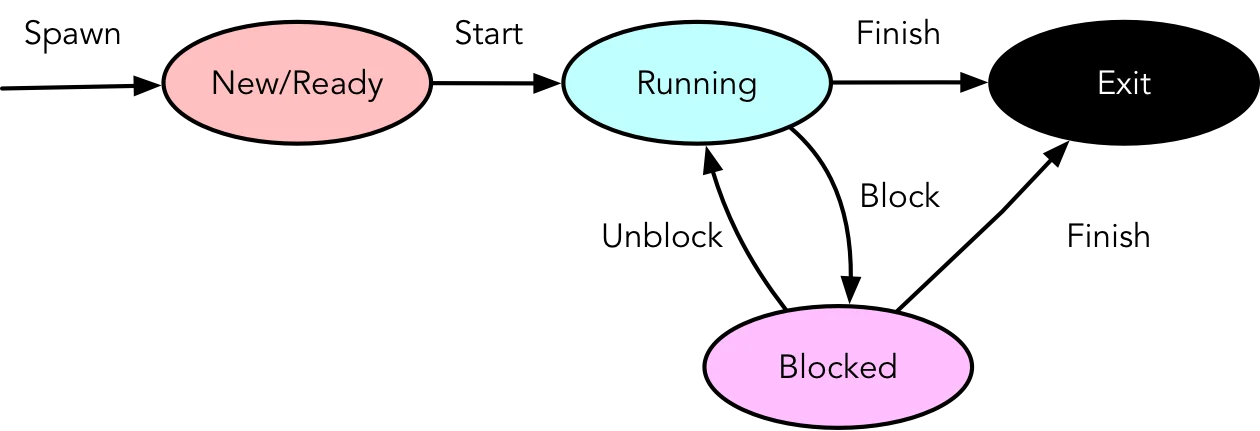 {width=400px}
Manages execution and synchronisation of threads in a multi-threaded environment:
- Spawn: Creation by another thread
- Block: Wait for an event (need not block process)
- Unblock: When event occurs
- Finish: Termination
Types of Threads
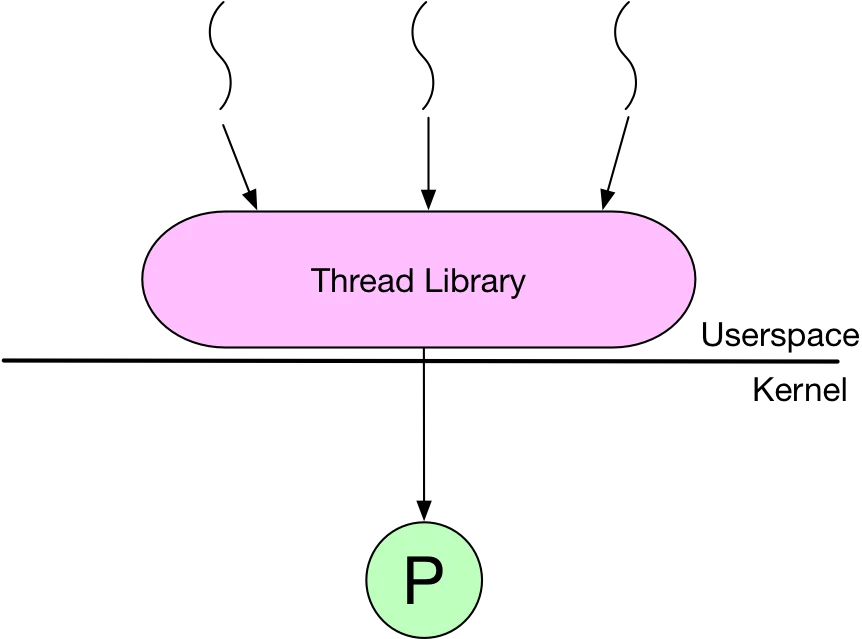 {width=250px}
User-level Threads (ULT)
- Managed by the application without kernel support
- Lightweight and fast to create and manage
- Threads are creating by the process
- Uses threading library
- Often used in Scientific Computing
- Many languages have ULT support
- Pros:
- No kernel mode switch to thread switch
- Application specific scheduling
- OS Independent (portable)
- Cons:
- Blocking syscalls blocks entire process
- Interprocess multiprocessing not possible
Kernel-level Threads (KLT)
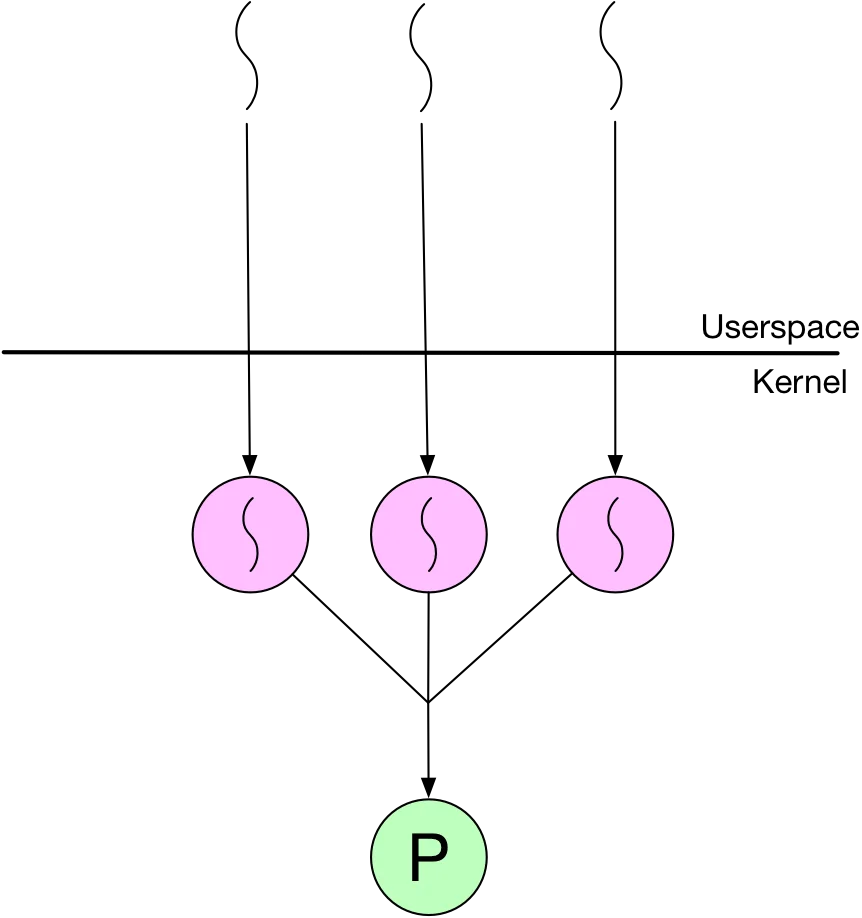 {width=250px}
- Managed by the kernel (i.e., the OS)
- Processes create threads via API (
pthreads) - Scheduling is handled by kernel
- Pros:
- Overcomes ULT disadvantages
- More robust
- Cons:
- Slower to create and manage compared to ULT
- Thread switch requires a mode switch
Hybrid Threading
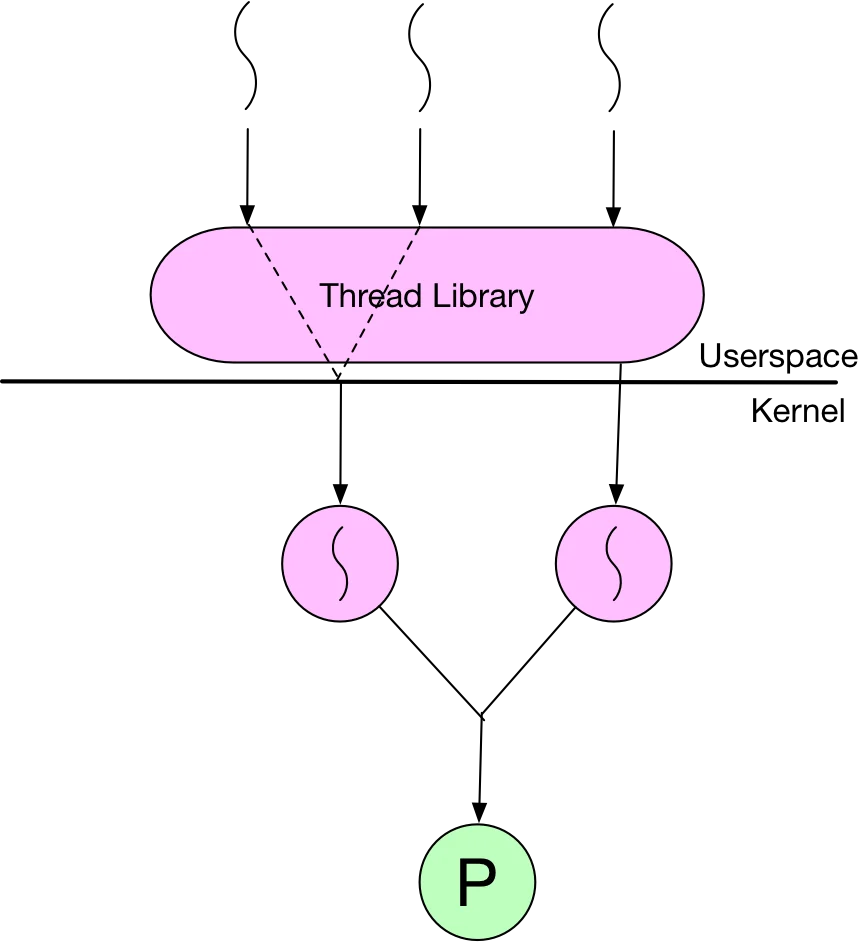 {width=250}
- Combines ULT and KLT
- ULTs mapped to (one or more) KLTs for multiprocessing
- Thread creating done in userspace
- Most scheduling done in userspace
- Example:
libdispatch