14. Page Tables
Real Time Operating Systems (RTOS) •
Paging in Practice
- The dominant model for virtual memory
- Some concrete examples from Intel and AMD
- ARM has similar memory management hardware
- Variations of pages used in different OS’ to optimise memory management
32b Intel Page Table Entry
 {width=550px}
| Bit | Name | Meaning |
|---|---|---|
| 1 | R/W | Enables writing to page |
| 2 | U/S | Marks page supervisor-access-only |
| 5 | A | Indicates page accessed recently |
| 6 | D | Dirty: page modified recently |
64b Intel Page Table Entry:
 {width=550px}
- Supports bigger virtual address
- 40b or 48b: no need for > 256 TiB right now
- Extensible: Can accommodate larger virtual address spaces if needed without requiring changes to underlying structure
- XD (execute Disable) for security
Page Table Size:
- For a system describing 32b of virtual and physical memory with 4 kiB pages and frames
- The total page size is 4 MiB
- Each frame number requires 20b; round up to 32b
Pages tables on 64b machines
- In the context of 64b machines, a page table would needs to be larger to hold entries for larger virtual and physical address:
- i.e., 4 petapages
Page Tables in Practice:
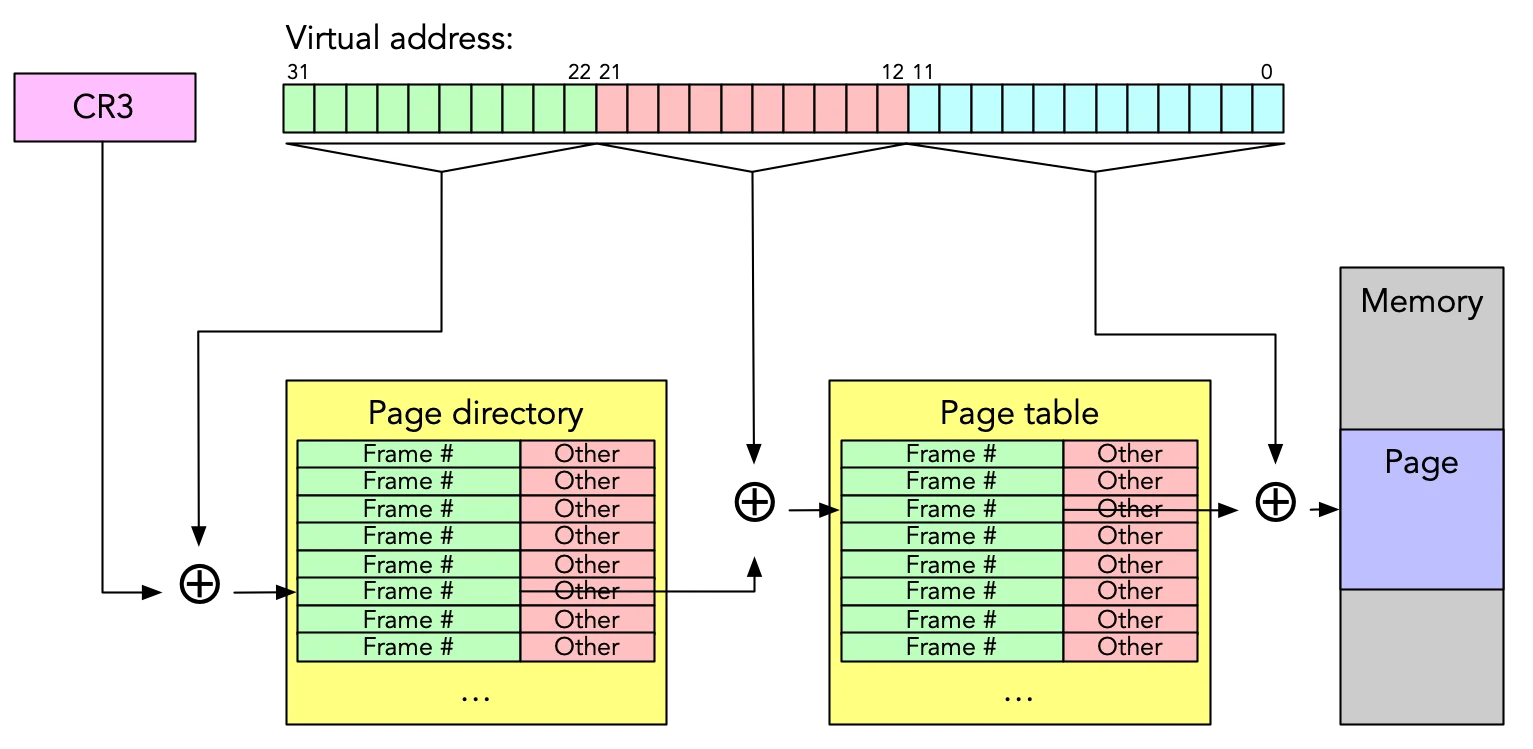 {width=450px}
- In practice, real page tables are not monolithic but structured as multi-level page tables
- Multi-level page tables create trees of pages
- tables of tables of pages
- every table fits in a page
- individual tables can be replaced (swapped out)
Two-level page table
- For paging in 32-bit systems
- Consists of two levels of tables to map virtual and physical addresses
One-level page table
- Simpler structure, but not suitable for handling extensive memory mappings
- Limitations in addressing large memory spaces efficiently
- Some OS’s use variations like superpages (BSD), huge pages (Linux), or large pages (Windows) instead
Four-level page table
- For paging in 64-bit systems
- Implemented in systems like AMD’x x86_64 and Intel’s IA-32e
- Workable (more scalable approach to memory management), but pretty indirect
Superpages in x86-64
- Supports omitting last-level page table, supporting up to 2 MiB pages
- Enhance performance by reducing number of page table lookups required for address translation (Reduces overhead)
Super-duper-pages in x86_64
- Supports omitting last two page levels, supporting up to 1 GiB pages
- Further reduces overhead