15. Page Faults
Real Time Operating Systems (RTOS) •
Why superpages?
- Used to reduce indirection in table walking…
- …which can help decrease frequency of page table access
- Primarily aimed at reducing TLB pressure
- Making memory access more efficient by utliising larger page sizes
Translation Lookaside Buffer
- Acts as a cache for the page table.
- Stores recently access virtual-to-physical address translations
- When a memory access is requestion, TLB is checked first to see if translation is already available
- Helps speed up memory access process
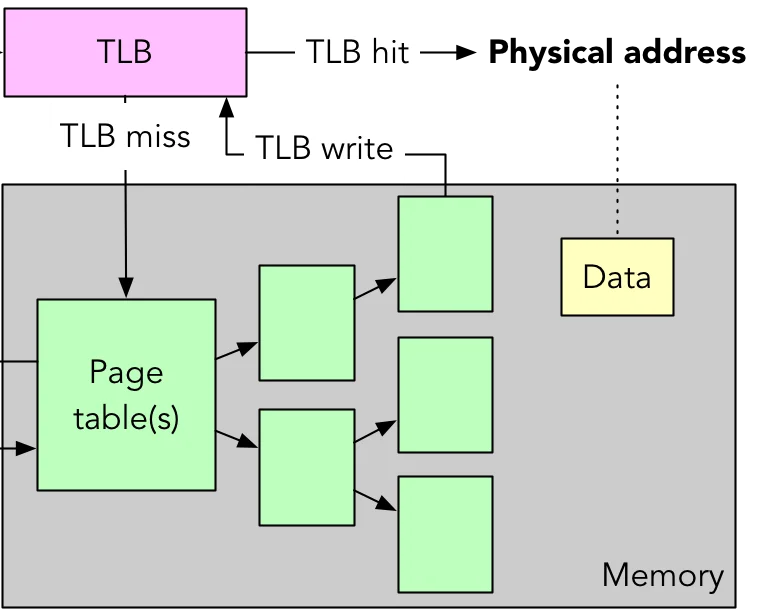
- If required access not found in the TLB, a a TLB miss
TLB Miss
 {width=250px}
- Happens when TLB does not contain the required translation for virtual-to-physical address mapping
- When a TLB miss happens, hardware page-table walker or OS must retrieve the translation from the page table
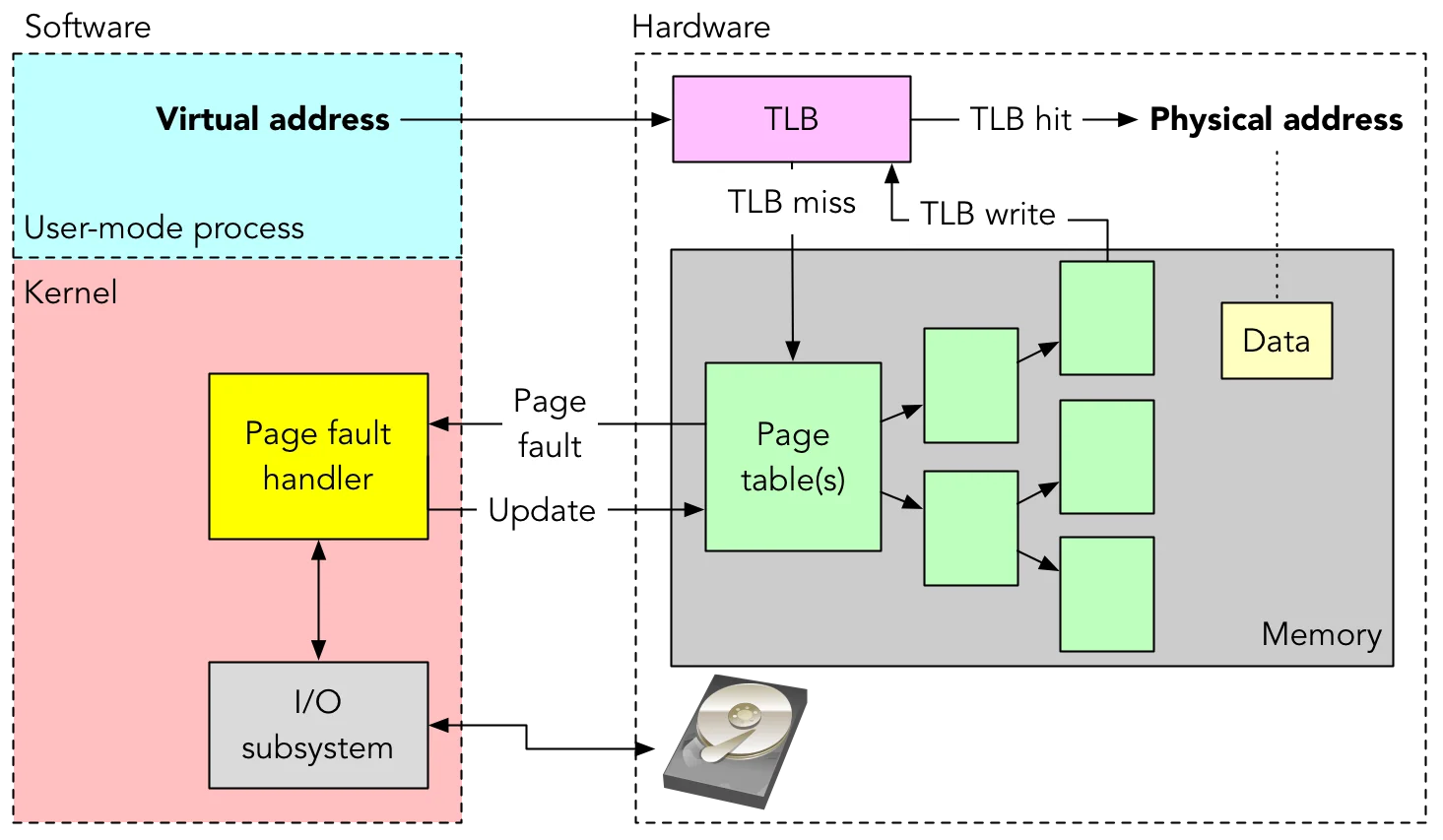
- If no entry in the TLB or the page table, Page fault
Page Fault
 {width=450px}
- Page fault handler triggered to handle the above situation by…
- Populating memory
- Updating virtual memory mappings
- Potentially fetching data from secondary storage (disk, network, etc.)
- This process ensures the required data is brought into memory and mapping is establish
- Done to allow program to continue execution
- Goal: Keep page faults to a minimum
- Page replacement
- Page fetching
- Buffering
- Resident size management
- etc.
Page Fetch Strategies
- Demand paging: Pages fetches only when needed
- Initially leads to many page faults, but decreases overtime due to temporal locality
- Prepaging: Preloads memory by exploiting secondary disk structure
- One page fault on startup
- Which one is better?:
- Prepaging is generally considered better, as it preloads memory and incurs only one page fault on startup, reducing initial delay in accessing pages.
Replacement Policies
- When loading from secondary storage, what should be replaced?
- Replacement policies dictate which page or frame should be replaced when a new page needs to be brought into memory
- Consider frame locking and R/W, U/S bits.
Optimal Strategy (Belady’s Algorithm):
- Evicts the page that will be used in the future
- Not always achievable due to lack of future knowledge of memory access patterns.
Least Recently Used (LRU):
- Replaces the least recently accessed page when a new page needs to be brought into memory
- Good for capturing temporal locality
- Almost as good as Belady in minimising page faults
- However, requires significant overhead to track usage of pages over time at each memory access
First-In-First-Out (FIFO)
- Replaces the page that’s been in memory the longest when a new page needs to be loaded
- Not a great strategy
- Some frames loaded early are used often
- can result in many page faults
- Does not consider the frequency of page accesses
Clock Strategy:
- Treats available pages as circular buffer
- Associates a use bit with each page
- When a page is accessed, set “A” bit
- When replacement is needed, scan buffer
- If “A” bit set, clear bit and move on (done by OS)
- Otherwise, page’s frame is replaced
- Better Why?:
- Protects frequently-used pages efficiently
- Reduces overhead in replacing unmodified pages
- Can also track dirty bit
Page Buffering:
- An add-on technique to replacement algorithm
- OS maintains two pools of pages
- Free, not modified
- Free, modified
- When a plage is “replaced”, it is placed in one of these pools first
- Checks pool first when page requested
Resident Set Management:
- Managing portion of process’ memory physically held in main memory
- VM system decides size of each process:
- Small: Lots of processes, higher page faults
- Large: Few processes, low multiprogramming
- Can be done through different modes of allocation:
- Fixed allocation:
- Number of frames fixed at process load time
- Can be equal or proportional allocation
- Page faults bump a page from the same process
- Variable allocation:
- Frames per process can vary over time
- Increase if page fault rate is high
- Decrease if slow
- Tracking page fault rates increases overhead by a little
- Frames per process can vary over time
- Fixed allocation:
Cleaning
- Periodically writing out modified pages to ensure the most up-to-date data is stored on disk
- Adds overhead of a page fault, but helps maintain data integrity and consistency
- Essential to ensure modified pages are saved before replacement, preventing data loss or corruption
- Demand Cleaning:
- Write out modifications as pages are replaced
- Adds to the overhead of a page fault
- Pre-cleaning:
- Periodically write out modified pages
- Allows us to write out in batches
- Both can be used with page buffering